The market has spent the last two years in a sprint to put agentic AI into security operations. Vendors are announcing autonomous agents, self-healing SOCs, and AI that investigates and responds without human intervention. It is a compelling pitch, and for security leaders trying to reduce analyst workload and close the detection-to-response gap, it is easy to understand the appeal. The harder question is what happens when the model goes wrong, and who owns that outcome.
At Critical Start, we have been asking that question since before agentic AI was a category. The answer is built into the architecture of everything we ship, and it is the reason we deliver SOC AI today. Our SOC AI is the framework of our multi-agent architecture that powers the Critical Start Platform. And unlike most of what the market is calling agentic AI right now, we have been building and hardening a deterministic ML foundation in our SOC for over a decade.
The story of SOC AI begins with the Trusted Behavior Registry® (TBR®) Agent, a deterministic machine learning engine that has run at production scale inside the Critical Start SOC since the company’s founding. The TBR Agent was built to solve a real and persistent problem in security operations: analysts spending investigation cycles on behaviors they had already confirmed as benign, over and over again across different customers and environments. The solution was not probabilistic AI inference. It was a human-curated knowledge base, built from more than a decade of confirmed real-world investigations, with every entry authored by a senior analyst and every rule explicit, reviewable, and auditable.
That knowledge base now filters approximately 99.8% of incoming events before they ever reach an analyst queue. It is the scaffolding that makes SOC AI possible, because it means every agent in the system is operating on top of a decade of validated, structured intelligence rather than learning from scratch or relying on a model that cannot show its reasoning.
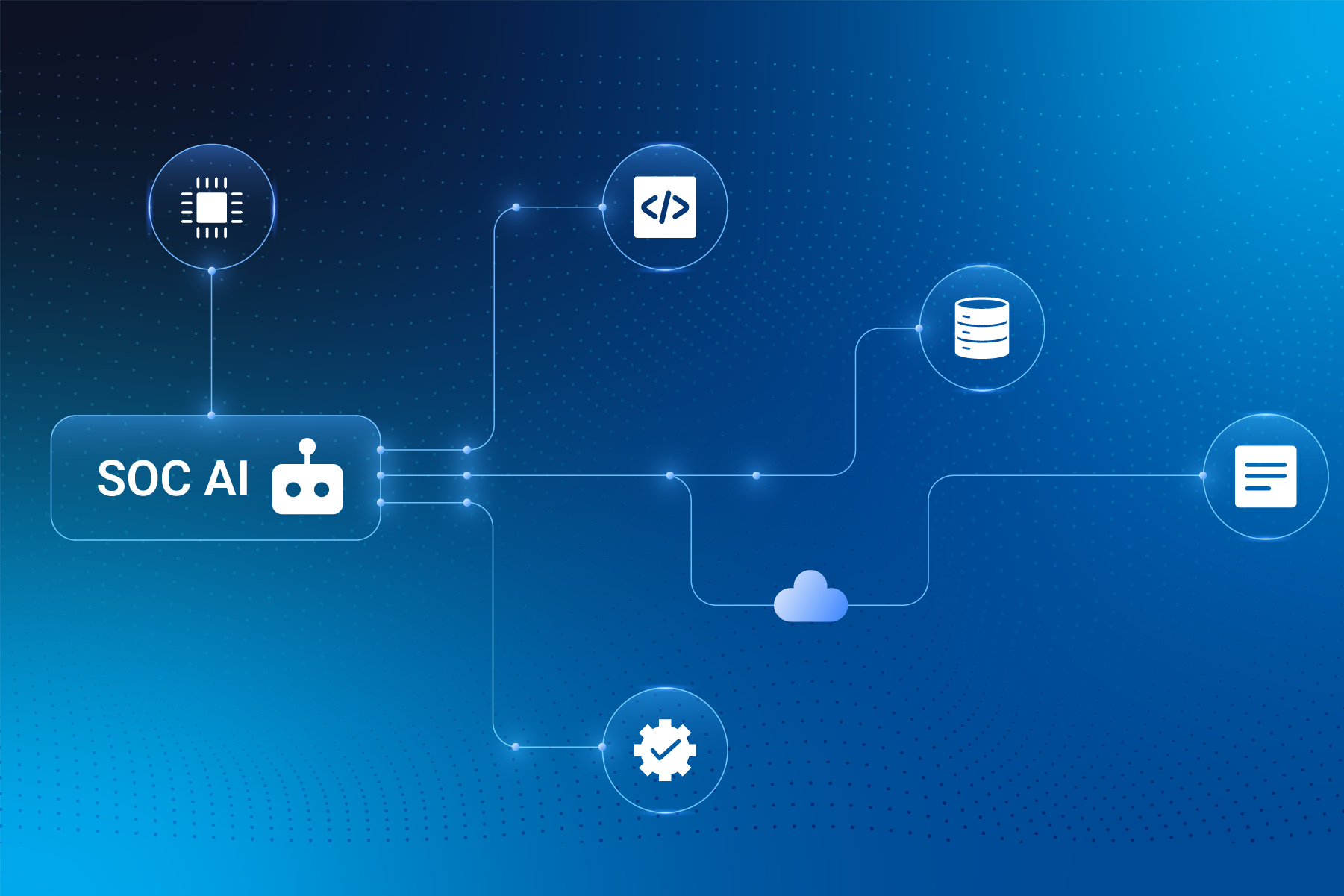
SOC AI coordinates ten specialized agents, each with a defined scope and no ability to act outside it. All agents operate through an abstraction layer with no direct console or API access to customer environments, which keeps the audit trail intact and the accountability model contractually defensible regardless of which agent is acting.
Every agent operates under the same three governing principles: speed, meaning AI compresses investigation time without replacing the analyst; safety, meaning all verdicts and response actions are made or validated by a qualified SOC analyst without exception; and transparency, meaning every AI recommendation carries a complete audit trail and we disclose where and how AI is involved at every step. Those principles are the reason SOC AI can be offered with contractual SLAs that hold regardless of whether AI was involved in a given investigation.
For security leaders evaluating agentic AI, the right question is not whether a vendor has agents. Most of them do at this point. The right question is whether those agents can be audited, contracted against, and trusted to fail gracefully when AI is unavailable. SOC AI is built to answer yes to all three. If AI is unavailable for any reason, the TBR Agent and the Critical Start SOC continue at full capacity. That is an architectural guarantee, not a contingency.
Every alert is investigated by a human analyst who owns the verdict. Every action taken inside a customer environment is logged and tied to contractual SLAs. The CORR Agentic Framework is not a roadmap toward those outcomes. It is the architecture delivering them at production scale today.
Critical Start is presenting SOC AI and the CORR Agentic Framework through interactive demos at Gartner Security & Risk Management Summit in National Harbor, Maryland, June 2 through 4, 2026. If you want to see what a production-proven agentic SOC looks like in practice, come find us.
